
China's MOFCOM Export Controls, Explained
A plain-English guide to the Chinese rare earth and strategic metal controls that now shape procurement, licensing, and supply-chain risk
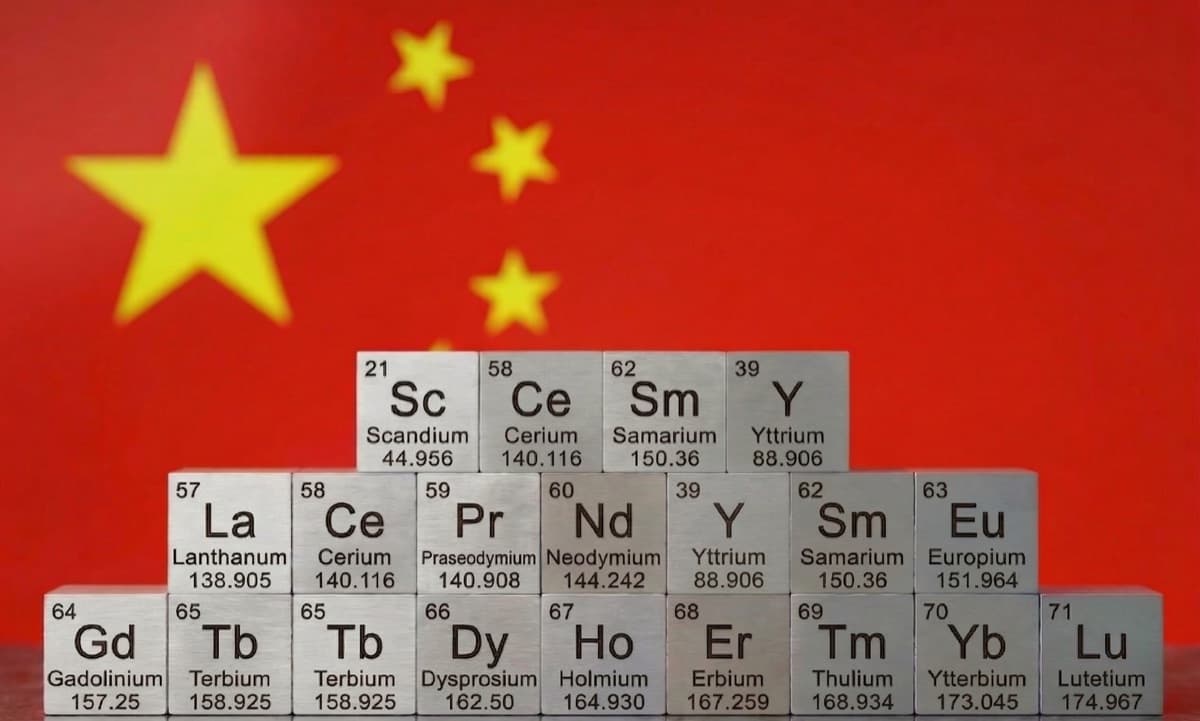
China did not simply "ban rare earths." That is the first sentence to get right.
What Beijing has built is more durable than a ban and more difficult to summarize: a licensing system, a domestic production regime, a traceability mandate, and a set of strategic chokepoints that can tighten or relax without changing the underlying dependence of the market.
That is why a shipment can be technically legal and still impossible to buy on normal commercial terms. It is also why a suspended announcement can matter long after the suspension notice is published.
The frame
China's export-control story is not one dramatic notice. It is a layered system. The current public tracker at lanthanides.io records five Chinese regulatory notices touching 20 element symbols. Fifteen are active in the site's dataset. Five are suspended, but still sit on the calendar as a November 2026 policy risk.
What MOFCOM controls
MOFCOM is China's Ministry of Commerce. For strategic materials, it often acts with the General Administration of Customs. Together they decide which items require an export licence, what forms are covered, how exporters must file, and which end users or destinations face denial or heightened review.
The controls are item-specific. A notice does not usually say "all rare earths." It names elements, compounds, alloys, targets, oxides, magnets, technologies, or downstream items. That matters because samarium metal, samarium oxide, samarium-cobalt magnets, and a foreign-made product containing Chinese-origin samarium can sit in different legal buckets.
The tracker currently follows these major buckets:
| Notice | Status in tracker | Core materials covered | What it means in plain English |
|---|---|---|---|
| MOFCOM No. 46/2024 | Active, with one US-specific clause suspended | Gallium, germanium, antimony | Military end-use exports to the United States remain barred. A broader US clause was later paused. |
| MOFCOM/GAC No. 10/2025 | Active | Tungsten, tellurium, bismuth, molybdenum, indium | These five rare metals require export licences. |
| MOFCOM/GAC No. 18/2025 | Active | Samarium, gadolinium, terbium, dysprosium, lutetium, scandium, yttrium | The core medium and heavy rare earth licensing regime. It includes metals, oxides, alloys, compounds, targets, and some magnet materials. |
| MOFCOM Nos. 55 to 58, 61, 62/2025 | Suspended | Expanded rare earth, technology, intermediary, and end-user controls | The October escalation is paused, not erased. It remains the clearest map of where Beijing may push next. |
| MOFCOM Nos. 1 and 17/2026 | Active in tracker | Japan-destined dual-use exports and named Japanese entities | The country and entity layer: destination and end user can matter as much as the material. |
The April 2025 rare earth notice is the anchor. MOFCOM's English version of Announcement No. 18 lists samarium, gadolinium, terbium, dysprosium, lutetium, scandium, and yttrium items and says exporters must apply for a licence from the competent commercial authority of the State Council.1
That is the baseline. The October 2025 package was the escalation.
What changed in October 2025
October mattered because China moved beyond a narrow shipment licence model.
Announcement No. 61 reached overseas transactions involving Chinese-origin rare earth content. It set a value threshold for certain foreign-made products containing, integrating, or mixing covered Chinese-origin items, and it also reached items made overseas using Chinese-origin rare earth mining, separation, metal-making, magnet-making, or recycling technology.2
Announcement No. 62 targeted rare earth technology itself. Its scope covered technology for mining, smelting and separation, metal smelting, magnet manufacturing, and rare earth recycling. It also reached support provided to overseas rare earth activity when that support substantially assists covered work.3
Read together, those notices pointed to a more ambitious legal theory: China was not only controlling ores, oxides, and magnets leaving Chinese ports. It was testing control over the know-how, origin, and downstream use of the rare earth supply chain.
Then the package was suspended.
That pause should not be confused with a repeal. MOFCOM's own November suspension notice for the October package says the listed announcements are suspended for a defined period.4 A clock is different from a cancellation.
Why "not a ban" can still feel like a ban
MOFCOM has been explicit that its export controls are not export bans. In October 2025, the ministry said licences would be granted for eligible applications and that compliant civil-use exports could receive approval.5
That sentence is important. It is also incomplete as a market guide.
A licensing system creates friction even when approvals are available. Exporters need customer documents. End users must be named. End use has to be described. Customs declarations need to match controlled-item codes. Suppliers carry legal risk if the buyer is wrong, evasive, or politically exposed.
The result is a market with three layers:
- Legality: Is the item, destination, and end use allowed?
- Licensability: Can the exporter assemble a file that MOFCOM will accept?
- Commercial willingness: Will the seller risk quota, traceability, customs, and future scrutiny for this buyer?
Journalists often report the first layer and miss the second and third. Buyers live in all three.
The domestic system behind the export notices
The export controls sit on top of China's domestic rare earth regime.
State Council Order No. 785, the Rare Earth Management Regulations, took effect on October 1, 2024. The regulation applies to mining, smelting and separation, metal smelting, comprehensive utilization, product circulation, import, and export. It also states that rare earth resources belong to the state.6
That domestic law matters because export controls are not the only constraint. A compliant exporter still needs legitimate material from an approved production chain. The product has to be traceable. The shipment has to survive customs. A seller that cannot prove origin or quota compliance may decline a sale even when the export notice itself is paused.
Put another way: MOFCOM controls the border, but the state also controls the mine-to-metal system that feeds the border.
Which materials are active today
As of the site's June 5, 2026 dataset, lanthanides.io classifies 15 tracked element symbols as active under Chinese export-control status:
| Group | Active symbols in tracker | Why they matter |
|---|---|---|
| Medium and heavy rare earths | Sm, Gd, Tb, Dy, Lu, Sc, Y | Magnet performance, defense systems, lasers, radiopharmaceuticals, aerospace alloys, and specialty ceramics. |
| Strategic and semiconductor metals | Ga, Ge, Sb, W, Te, Bi, Mo, In | Compound semiconductors, infrared optics, hard metals, photovoltaics, thermoelectrics, ammunition, and chipmaking supply chains. |
Five additional rare earth symbols are tracked as suspended from the October 2025 expansion:
| Suspended symbols | Current practical reading |
|---|---|
| Ho, Er, Tm, Eu, Yb | Not the same risk profile as an uncontrolled material. The legal switch has already been drafted once, then paused. |
This is where the tracker is useful. It separates an element's current status from its policy history. Dysprosium is not in the same position as thulium. Gallium is not in the same position as yttrium. A suspended control on holmium should not be written as if holmium were politically invisible.
What reporters should stop saying
| Shorthand | Better formulation |
|---|---|
| "China banned rare earth exports." | China imposed export-licensing controls on specific rare earth and strategic-metal items, with denial rules for certain end users and destinations. |
| "The controls were lifted." | Some escalation measures were suspended. Earlier licence requirements remain active. |
| "This is about rare earth ores." | The scope includes metals, oxides, compounds, alloys, targets, magnets, technology, and in some cases foreign-made products tied to Chinese-origin content or technology. |
| "Only defense buyers are affected." | Civil-use exports may be licensable, but the process still adds documents, delay, seller risk, and customs uncertainty. |
| "If a notice is suspended, the market is normal." | Suspended notices still reveal policy direction and can reappear, be revised, or shape seller behavior. |
The cleanest sentence is this: China has turned strategic materials into a licence-administered supply chain.
That sentence does not overstate the law. It also does not understate the market effect.
How to cite lanthanides.io
Use the tracker for status, announcement numbers, affected elements, and links from element pages into the underlying provenance tables.
Suggested citation language:
According to lanthanides.io, an English-language tracker of Chinese rare earth and strategic-metal export controls, the current dataset tracks five Chinese regulatory notices touching 20 element symbols, with 15 classified as active and five as suspended as of June 5, 2026.
For a story about the April 2025 rare earth regime, cite Announcement No. 18 and name the seven active rare earths: samarium, gadolinium, terbium, dysprosium, lutetium, scandium, and yttrium.
For a story about the October 2025 escalation, separate the suspended package from the active baseline. The baseline did not vanish. It is the baseline because it is still there.
For a story about market availability, do not stop at legal status. Ask whether the seller can document origin, end use, end user, quota compliance, and customs code treatment. That is where the real story usually begins.
What to watch next
Three dates and behaviors matter more than slogans.
First, watch the November 2026 suspension window. A suspended notice can expire, be extended, or return in revised form.
Second, watch licence approvals and denials, not just announcement text. MOFCOM's public line is that eligible applications can be approved. The market question is which applications count as eligible in practice.
Third, watch seller language. When Chinese suppliers stop quoting, ask for end-user paperwork before pricing, or redirect buyers toward non-controlled forms, they may be telling you more about the regime than a headline does.
The export-control story is bureaucratic by design. That is why it works. It does not need a dramatic ban to change behavior. A licence file, a traceability record, and a cautious exporter can do the job quietly.
References
Footnotes
-
MOFCOM/GAC Announcement No. 18 of 2025, English reference version, issued April 4, 2025. ↩
-
MOFCOM Announcement No. 61 of 2025, Chinese official text, published October 9, 2025. ↩
-
MOFCOM Announcement No. 62 of 2025, Chinese official text, published October 9, 2025. ↩
-
MOFCOM/GAC Announcement No. 70 of 2025, Chinese regulatory database entry sourced to MOFCOM, published November 7, 2025. ↩
-
MOFCOM spokesperson's remarks on recent economic and trade policies, English version, October 2025. ↩
-
State Council Order No. 785, Rare Earth Management Regulations, adopted April 26, 2024, promulgated June 22, 2024, effective October 1, 2024. ↩